

Why Does It Feel Like I'm Never Doing Enough As A Mom?
Vol. 9


Dear Mamas,
This week’s letter is one that’s been close to my heart for a long time. And I’ll be honest, it’s taken me a while to figure out how to put it into words, because it’s about something we don’t often name out loud, even though most of us feel it every single day.
That feeling of always being on. Always observing. Always doing a quiet calculation in the back of your mind: what needs doing, who needs what, what’s been missed, what’s coming next. That low hum of never quite landing. Of rest that doesn’t actually feel like rest. Of giving so much and still somehow feeling like it’s not enough.
Sound familiar?
This week I want to sit with that feeling, look it in the eye, and talk honestly about where it comes from and what we can actually do about it. No quick fixes, no magic pills (wouldn’t that be great?!). Just a real conversation, and a place to start.
Give me five minutes. I think this one will stay with you.
Let’s go…
Let me paint you the scene
It’s Saturday afternoon. The kids are finally — finally — quiet for twenty minutes. Your partner is on the couch. Feet up. Show on. Snack in hand. Completely, blissfully unbothered.
And something in you tightens.
It’s not just jealousy. It’s something older and uglier than that. It’s the heat that rises when you realize you haven’t sat down since 7am, that the laundry is a mountain, that you mentally drafted three grocery lists and a pediatrician question before 9am…and none of that counts as “work” to anyone, including sometimes yourself.
So why aren’t you on the couch?
Here’s what I think: it’s not because you’re a better parent. It’s not because you care more. It’s because somewhere along the way — long before the kids, long before the relationship — you were taught that a woman at rest is a woman failing.
We were trained this way
Think about how you were raised. Think about the women around you growing up: your mom, your aunties, the mothers in your neighbourhood. Were any of them just... sitting? Or were they always in motion? Always anticipating the next need, the next mess, the next person who required something from them?
We absorbed that. Deeply. We learned that productivity equals worth. That a tidy house reflects your character. That if the kids are fed and bathed and stimulated and emotionally regulated, that’s Tuesday, not an achievement. We learned to do the work and then immediately scan for more work, because stillness felt dangerous. Like something must be wrong if there’s nothing left to fix.
When we have children, the mental load explodes.
The mental load never clocks off
The mental load isn’t just the tasks. It’s the knowing. It’s carrying the entire operating system of a family in your head at all times. It’s knowing which kid is low on socks. It’s knowing the permission slip is due Friday. It’s knowing your toddler has been off this week and probably needs an earlier bedtime, and also that you’re out of the only yogurt they’ll eat, and also that you haven’t called your mum back all week and you feel guilty about that too.
It runs constantly. In the background. Even when you look like you’re just watching TV. Even when you’re in the shower. Even when you’re trying to sleep.
Your partner, meanwhile, can genuinely turn it off. Not because they’re selfish (well, maybe sometimes because they’re selfish). But often because no one ever handed them the operating system. They were never expected to hold it. So they don’t.
And that gap — that invisible, exhausting, completely unacknowledged gap — is where resentment is born.
The resentment that curls back on you
Here’s the part no one tells you: the resentment isn’t just toward your partner. It curls back on you too.
Because if you do finally sit down — if you do decide, just for today, to let the dishes be someone else’s problem — you probably can’t even enjoy it. Your brain is still running the checklist. You’re half-watching your show and half-clocked on what needs doing. And then you feel guilty for not being present. And then guilty for not resting properly. And then you get up and do the dishes because at least that feels like something you can control.
This is the trap. The one they don’t warn you about in any baby class, any parenting book, any well-meaning “self-care Sunday” post on Instagram. You cannot just decide to rest when your entire nervous system has been rewired around vigilance. Rest has to be relearned back into your body. It has to be practised, protected, and critically not apologised for.
The impossible standard no one officially set
The one that says you should be present but also have interests. Patient but also firm. The house should look lived-in but not chaotic. The kids should be thriving but not over-scheduled. You should be working on yourself but also always available. You should ask for help but not too much because then you’re a burden. You should want less but somehow also do more.
It is an unwinnable game. And we play it every single day.
What you’re doing is not nothing. It is, in fact, everything. And you’re doing it largely unseen, largely unthanked, and largely while critiquing yourself for not doing it better.
Busyness is anxiety in disguise
So. What do we actually do with this?
I’m not going to tell you to book a spa day or wake up before your kids for a quiet morning routine (genuinely, who has the energy?). What I want to talk about is something harder and more real: learning to rest again. Not as a reward. Not when everything is done. But as a practice. The same way your nervous system practised vigilance for years until it became the default.
Here’s the thing that took me a long time to understand: a lot of what looks like dedication — the inability to sit down, the constant scanning, the compulsive tidying at 10pm — is actually anxiety wearing productivity as a costume.
Keeping busy is a regulation strategy. When you’re doing something, you’re not sitting with the low hum of dread that something is wrong, something is missing, something is about to go sideways. The doing drowns it out. The problem is it never actually resolves it. The anxiety just waits, and the to-do list grows, and the bar keeps moving, and you keep running toward it. Rest threatens to remove the one thing that’s been keeping the anxiety quiet — which is exactly why it feels so dangerous to stop.
That’s not laziness. That’s not weakness. That is a nervous system that learned to use busyness as armour. And you can unlearn it. Slowly, gently, with a lot of patience for yourself. Here’s where to start.
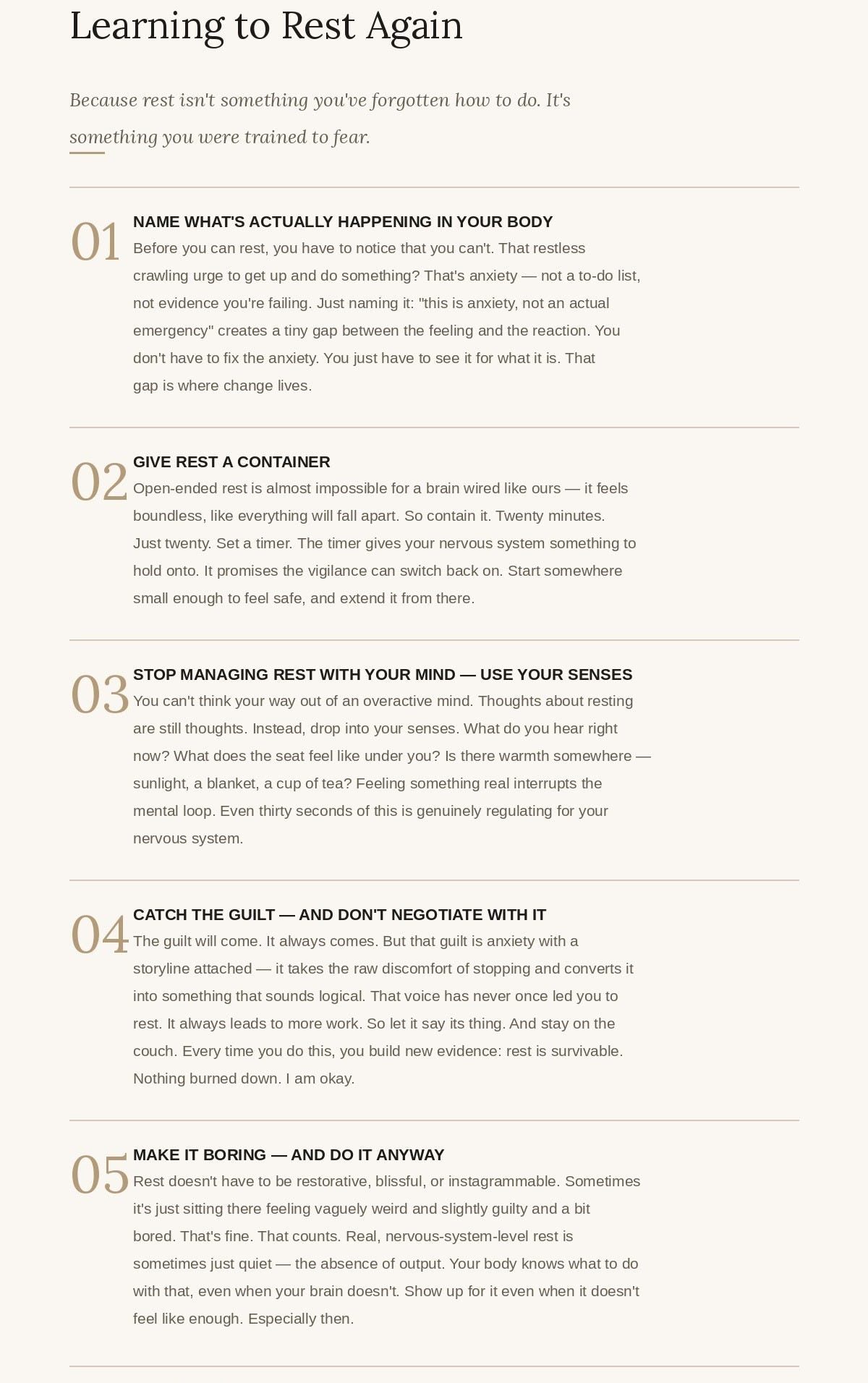
What happens when you keep showing up for it
Here’s what I want you to hold onto — the part that actually makes this worth doing.
Every time you rest intentionally — every time you sit down, feel the anxiety rise, and choose to stay anyway — you are sending your nervous system a new message. You are teaching it, slowly and gently, that stillness is not a threat. That nothing terrible happens when you stop. That you are safe.
Your nervous system learns through repetition and evidence. It got wired for vigilance through years of being told, directly and indirectly, that a woman who stops is a woman failing. It is going to take more than one twenty-minute sit to unwire that. But here’s what’s true: it does unwire. With consistency, it does!
Think of it less like a task to complete and more like a signal you’re sending throughout the day. A two-minute pause before you get out of the car. Sitting with your tea instead of drinking it while you’re doing something else. Five deep breaths before you go back into the chaos. These small, intentional moments of rest are not indulgences — they are resets. They are you interrupting the loop. Showing your body that it doesn’t have to stay in a constant state of high alert just to get through the day.
Over time, not immediately, but over time, you will notice a shift. The buzz quiets a little. The guilt loses some of its grip. The couch starts to feel less like a place where you’re failing and more like a place where you’re actually doing something important: teaching your nervous system that you are okay. That you are enough. That this moment, right here, does not require your full vigilance.
That is not laziness.
That is one of the most genuinely nourishing things you can do for yourself, and honestly, for everyone around you. A mother who has learned to regulate herself is a mother who has more of herself to give. Not because she’s giving more, but because she’s giving from a place that isn’t completely depleted.
So start small. Start today. Not as another thing on the list, but as a quiet, radical act of choosing yourself. Again and again and again, until your nervous system finally gets the message:
You are allowed to rest. And you are safe when you do.
— xo, Ashley
If this landed for you, share it with a mama who needs to hear it. Or just sit with it for a minute. You don’t have to do anything with it right now.